
Could educational choice funding pay for public schools?
Sure, but for a very short period of time.

A common critique from opponents of educational freedom is that choice programs deprive public schools of valuable resources. According to this theory, opponents claim that choice programs would lead to lower outcomes for public school students due to “larger class sizes and fewer resources.”
However, the research tells a different story, as 26 of 29 studies on the impact of choice programs on public school students' test scores show positive results, plus improvements in attendance and behavioral outcomes. The positive outcomes are likely due to competitive effects and the opportunities for families to match their students with a better learning environment.
Nevertheless, we wanted to examine the argument that educational freedom busts state budgets. To do this, we calculated private educational choice’s cost share of total K-12 funding and state expenditures. Then, we calculated how many days the funding for choice programs could run traditional public schools.
By comparing how much is spent on private school choice to how much states spend in total and on K-12 in particular, school choice’s small budgetary sliver becomes obvious. You can’t bust a budget if you are only a fraction of a single percent of it.
Our analysis examines 68 programs across 28 different states. It includes various types of choice programs, such as tax-credit scholarships, vouchers, and education savings accounts of different sizes, including those with universal eligibility requirements.
For how long could the state operate its public schools, assuming that every penny spent on the private school choice programs becomes part of the K-12 budget? The answer is not very long at all. In fact, no state could operate its public school system using choice funds alone for an entire month.
Florida is the closest, as it could sustain its public schools for approximately 16 and a half days, equivalent to about three school weeks. Meanwhile, no other state, except Arizona, which could maintain its public schools for nearly 13 days before closing, could operate for more than 8 days.
The calculation for determining the cost share of the private school choice programs compared to K-12 spending involves dividing the cost of choice programs by K-12 revenues from fiscal year 2023 (the most recent year that school finance data from the USDOE are publicly reported). A similar method is employed to calculate the cost share of private school choice programs compared to total state expenditures by substituting K-12 revenues with state budget costs.
Calculating the number of days private school choice program funds could operate public schools involved dividing the total K-12 revenues for fiscal year 2023 by 180 — the average number of school days in most states. This calculation yields the average one-day cost of running public schools. The private school choice cost was then divided by the average one-day cost to estimate how many days the choice funds could operate public schools.
The table below shows that despite private school choice programs steadily growing for years, they remain a small percentage of overall K-12 spending. The most recent cost share of private choice programs is less than 1% of total K–12 revenues, for most states. Only Arizona (6.98%), Wisconsin (4.07%), Indiana (2.89%), Florida (7.46%), and Ohio (3.21%) have a cost share higher than 2%. This demonstrates that choice programs expand family options without significantly displacing public school funding at the system level.
But what about the claim that choice programs bust state budgets? The table also shows that, in comparison to total state expenditures, funding for private school choice programs is a mere drop in the bucket. Even after decades of operation in some instances, the cost share of private choice programs is well below 1% of total state spending.
Only a few states, including Ohio (1.03%), Arizona (1.27%), and Florida (2.64%), spend slightly more than 1% of their total state expenditures on their choice programs. In fact, most states allocate 0.1% or less of their budgets to private school choice programs.
This means that school choice programs account for a fraction of every dollar spent across all public services, including health care, public safety, and higher education. Even in states with long-running or larger programs, the budgetary impact is negligible. Private school choice programs do not strain state funding for other public services.
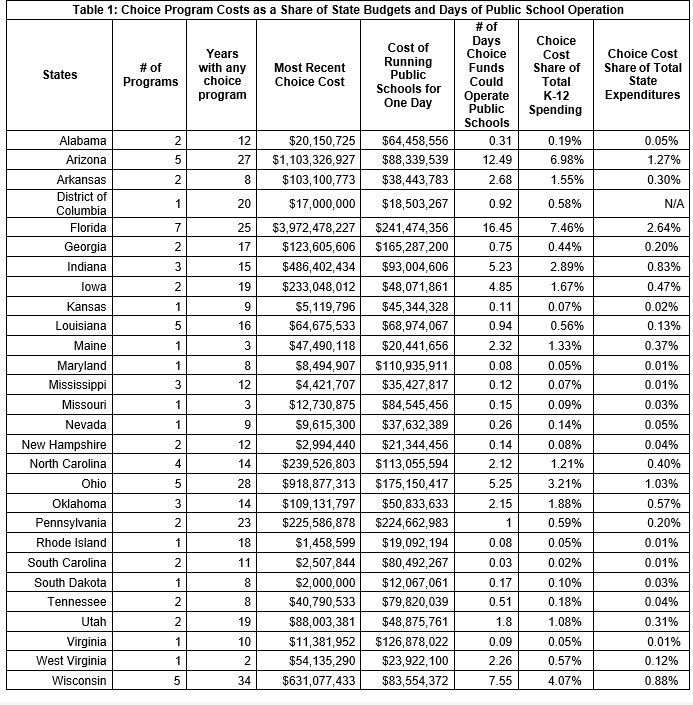
Sources: Author’s calculations using data from National Center for Education Statistics, U.S. Department of Education; National Association of State Budget Officers; Martin F. Lueken (2024). The Fiscal Effects of School Choice: The costs and savings of private school choice programs in America through FY 2022, EdChoice, October, https://www.edchoice.org/wp-content/uploads/2024/10/Fiscal-Effects-2024.pdf
Disclaimer: Readers should note that the discussion throughout this piece centers on choice costs only. It does not factor in any way the savings that choice programs generate when students leave public schools via choice programs. Audiences should care about the net fiscal impact of these programs instead of just the costs. However, given all the focus on how choice funding might affect public school systems, this piece looks solely at the latest available cost data.
 | A guest post by
|