
Out and About
EdChoice research in the wild!

Happy Tuesday. The school year is drawing to a close across the country. Teachers and students are eyeing the exits. Pools are getting chlorinated. Pontoon boats are getting gassed up. Summer is nearly here.
On Saturday morning, I was on C-SPAN’s Washington Journal talking about our new teacher survey. You can watch all 40 minutes here.
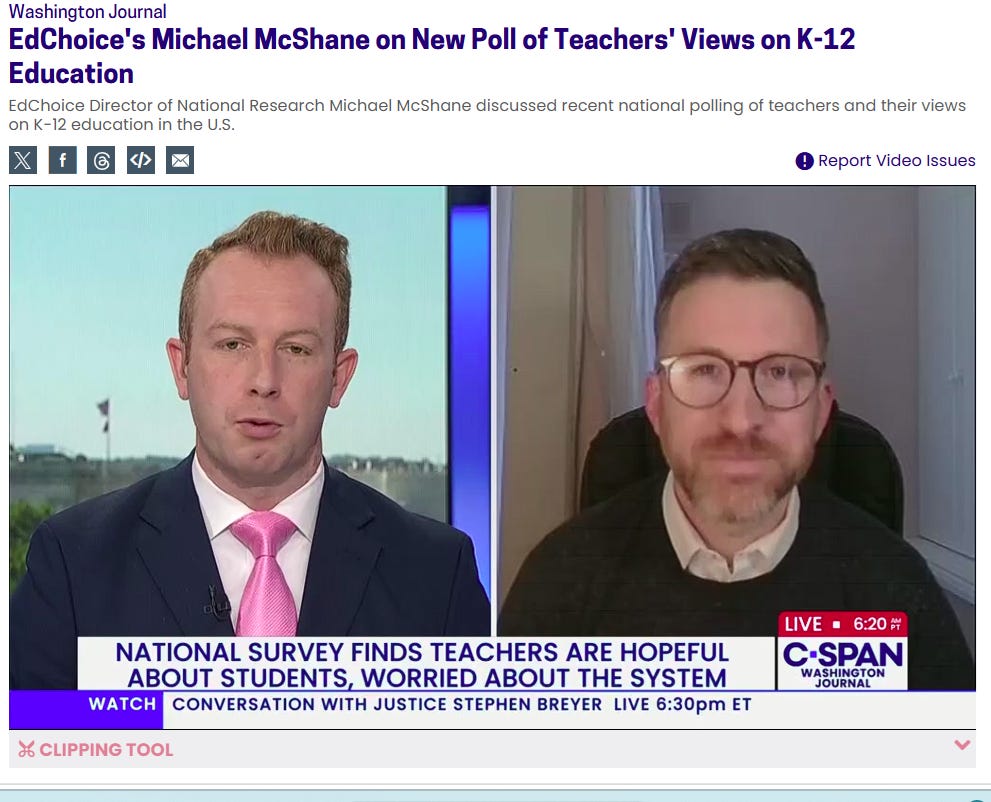
It was an interesting experience, because on one hand I find C-SPAN’s policy of opening up the phone lines and letting folks say their piece to be utterly charming. It is important to our democracy and society to have spaces where people can respectfully share their ideas, disagree with one another, and both speak and be heard by a wider audience.
If I had one tiny qualm, it was that the callers rarely engaged with the data presented by either me or the host, who kindly displayed many of the report’s charts on screen so viewers could examine them for themselves.
That did reinforce for me how opinions about education are formed and fortified.
People’s opinions about schools are shaped by their direct experiences. Where they went to school, where their children or grandchildren go to school, where they taught or currently teach, these are the places that determine what people think about schools. Data on national trends is interesting, but ultimately far less important than direct experience. Not saying whether that is right or wrong, that is just the way it is.
People wanted to talk about their experiences, not our data. Glad they had the chance to.
I’d also like to highlight a webinar we are putting on later today. At noon Eastern, we’re releasing a revised and updated version of my paper The Accountability Myth.
First published in 2021, The Accountability Myth challenged a common argument made by school choice opponents: that public dollars should not go to private schools because public schools are accountable while private schools are not.
Most choice advocates (rightly) argue with the second part of that claim, demonstrating the myriad ways in which private schools are accountable. But I wanted to do something different. I wanted to take issue with the first part of that statement, because I don’t believe that public schools are accountable themselves.
The paper walked through the three ways in which we typically think about school accountability (financial, democratic, and performance) and explained how public schools are not held accountable across any of these dimensions.
I don’t want to spoil the new edition, so I’ll let you guess whether I found that public schools had become meaningfully more accountable in any of these areas over the intervening five years.

Anyway, I offer some new data and follow up on stories from the first edition in what I hope are interesting and illuminating ways.
You can register for the webinar launching the paper here.
We’re going to be taking a break for Memorial Day. EdChoice is headquartered in Indianapolis, which hosts the Indianapolis 500 every Memorial Day weekend. In one of those fun regional quirks of the United States, the Friday before is known as “Carb Day” and is an unofficial Indianapolis holiday.
(To show you what a non-Hoosier I am, when I first heard Carb Day referenced, I though it meant the macronutrient. It references the auto part.)
So as a shout out to Carb Day, we’re not going to publish on Friday. We’ll be back with you on Tuesday the 26th.
As one small Memorial Day tribute, I’ll close with two stanzas from Laurence Binyon’s “For the Fallen”:
They went with songs to the battle, they were young,
Straight of limb, true of eye, steady and aglow.
They were staunch to the end against odds uncounted;
They fell with their faces to the foe.
They shall grow not old, as we that are left grow old:
Age shall not weary them, nor the years condemn.
At the going down of the sun and in the morning
We will remember them.
God bless their memory. Have a wonderful long weekend.