
The Texas EFA Program, Explained
An update on Texas-sized enrollment numbers

Refer Informed Choice to a friend. If they sign up, you’ll be entered in a drawing for a $100 Amazon gift card. Here is the link:
Have a choice research related question you’d like the team to answer? Feel free to send it to informedchoice1996@gmail.com and you might see it answered in a future Informed Choice post.
My colleague Alli Aldis wrote a great piece last week detailing the initial surge in applications for the Texas EFA program, comparing it to other states’ first few months after launching their education savings account programs. This piece will serve as an update, as applications for the program have crossed a critical threshold.
The Texas Education Freedom Account (EFA) program application window opened to Texas families on February 4th. As of writing, more than 100,000 students have submitted their application to participate in the program this upcoming year. Demand for the program is so strong that by the end of the first day the program had received over 30,000 applications, including 8,000 in the first hour!
This level of demand validates the hard work of parents, advocates, and policymakers who fought for years to make educational freedom possible for families in Texas.
Below I’ll discuss the key details of the program, what we know so far about the applicants, and what this could mean going forward in Texas.
Overview of the TX EFA Program
The Texas EFA program is Texas’ first private educational choice program, beginning in the fall of 2026. The Texas legislature appropriated $1 billion in funding to the program, which means roughly 90,000 accounts will be funded in the first year. It is an ESA program with universal eligibility, meaning all K-12 students in the state are eligible to apply.
Families that enroll their child in an accredited private school will receive a scholarship worth $10,474, while homeschooling families will receive $2,000 in funding. Students with disabilities can receive up to $30,000 in funding.
Funds may be used on private school tuition and fees, as well as other approved expenses such as textbooks, uniforms, classes and services provided by a public school district, assessments, tutoring, and transportation, among others.
While the program features universal eligibility, there is a multi-tiered priority system to determine which students are awarded scholarships under the funding cap. The priority system for the first year is as follows:
1. Children with a disability who are members of a household with an annual income at or below 500% FPL (roughly $160,000 for a family of four)
2. Children who are members of a household with an annual income at or below 200% FPL (roughly $64,000)
3. Children who are members of a household with an annual income between 200% FPL and 500% FPL (between $64,000 and $160,000 for a family of four)
4. Children who are members of a household with an annual income at or above 500% FPL, who were enrolled in a TX public school or charter school for at least 90% of the prior school year
5. Children who are members of a household with an annual income at or above 500% FPL
The program is overseen by the Texas Comptroller of Public Accounts, while Odyssey was selected as the certified educational assistance organization (CEAO) to help administer the program.
What We Know So Far
Because applications are still flowing in (the window closes on 3/17), it will take some time before we have a good idea of what types of students applied for the program. It is also looking like the program will be oversubscribed, so we will have to wait to see how these applications filter through the priority tiers to find out who is actually able to participate in the program
According to statute, each year the Comptroller’s office and the CEAO will publish an annual report detailing the following data:
Number of applications received, accepted, and waitlisted
Participant satisfaction
Assessment results
Key demographic data including:
-Grade
-Age
-Gender
-Race/ethnicity
-School district in which the child resides
-Zip code
-Priority category
-Disability status
There are more reporting requirements outlined in the statute as well. This is great. We at EdChoice have written at length about the importance of demographic data and reporting on ESA programs.
Thanks to the diligent work of those in the Comptroller’s office, we were able to sneak a peek at some applicant data.
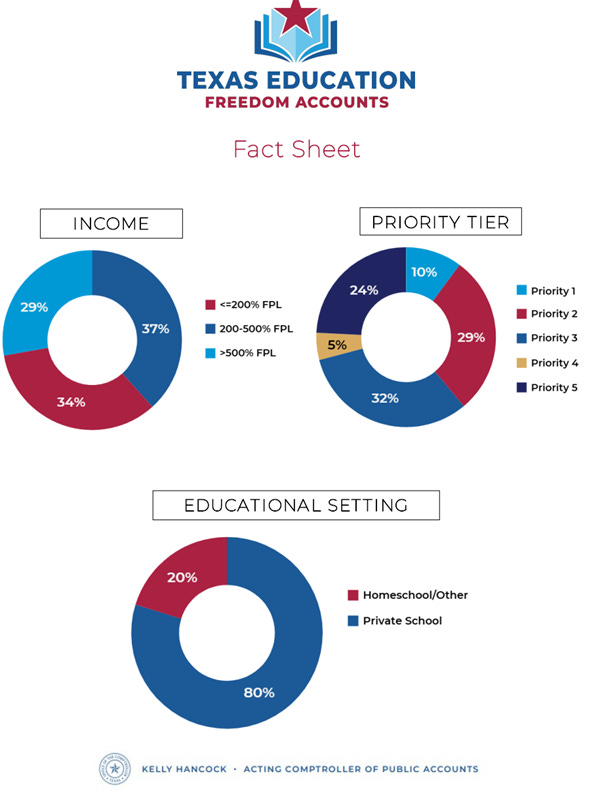
As of late last week, just over one-third of applicants came from households earning equal to or less than $64,000. The largest group, 37%, comes from households earning between 200% and 500% FPL, while 29% of applicants come from households earning 500% FPL or more.
Most of the applicants attend an accredited private school, while only 20% are homeschooling families. It is important to note that this data is subject to change, and the characteristics of families that applied might not be the same as those who ultimately participate. That said, we are very appreciative of the Comptroller’s office and Odyssey for sharing a glimpse of the initial data with us.
Going Forward
The massive influx of applications is undoubtedly a great sign for the program and for Texas families. As I mentioned above, however, the initial funding for the program for this year, while quite significant, will fund around 90,000 students.
The final number of students who will receive funding to participate in the program is still to be determined. Students receive different amounts depending on their eligibility category and priority. The topline participation figure will depend on how many students with disabilities apply for the program, and how much their scholarships are worth (up to $30,000). It will also depend on how many homeschooling families are in the program, as they are granted $2,000 in funding. There is no language in the statute that outlines how many of each category can participate, so we are in wait-and-see mode in terms of the final number of funded scholarships.
Given that applications have already breached the 100,000 mark, there are almost certainly going to be families placed on a waitlist for the program. We’re seeing states not too dissimilar to Texas, like Florida, eliminate waitlists through universal funding (funding for all students who apply and are eligible for the program).
My colleague Marty Lueken penned some wise words in a recent substack post discussing funding parity – “Choice policy has spent decades focused on access. The next phase, likely more incremental and longer-term, must focus on alignment between students, funding, and opportunity.”
Texas, with this EFA program, hit a home run in terms of access. Each of the 5 million+ K-12 students in Texas are eligible to apply for the program. Their next hurdle comes in the form of funding and opportunity. If they have similar success clearing these hurdles, Texas has a clear path to becoming the leader in educational freedom in the nation. Ambitious, yes. Unimaginable, no.
 |
|