
What a Difference A Year Makes
Teacher optimism rebounds from 2024 to 2025

Our spring 2024 survey of teachers was, in my opinion, the grimmest survey report we’ve released in our nearly four years of public opinion research.
When asked if they felt K-12 education at the national level was heading in the right direction, only 19% of teachers agreed.
More concerning was the level of optimism towards K-12 education at the local level, typically hovering around 50%. It had fallen to 39%. Both figures represented all time low levels of optimism observed in the four-year history of EdChoice’s Public Opinion Tracker.
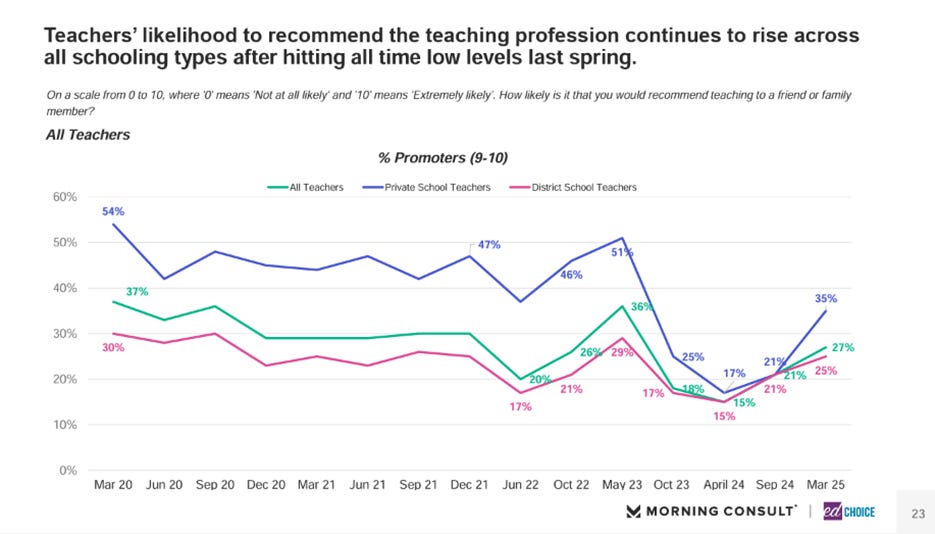
Our other main measurement of teacher attitudes comes from asking teachers how likely they are to recommend the teaching profession to a friend or family member. This too experienced a complete bottoming out, as only 15% of teachers said that they would recommend the profession. This was even true for private school teachers, only 17% of whom told us that they would recommend the profession.
At face value, those figures may not seem all too shocking. It is not until you realize that just one year prior, in spring 2023, 36% of all teachers and 51% of private school teachers said they’d recommend the profession. 2023 to 2024 represented a startling 21-point drop for teachers on average and a 34-point drop for private school teachers.
A year has passed, and we have new survey data from teachers that we can dissect. Thankfully, our spring 2025 survey of teachers has far more upbeat results. I encourage everyone to read the full report here.
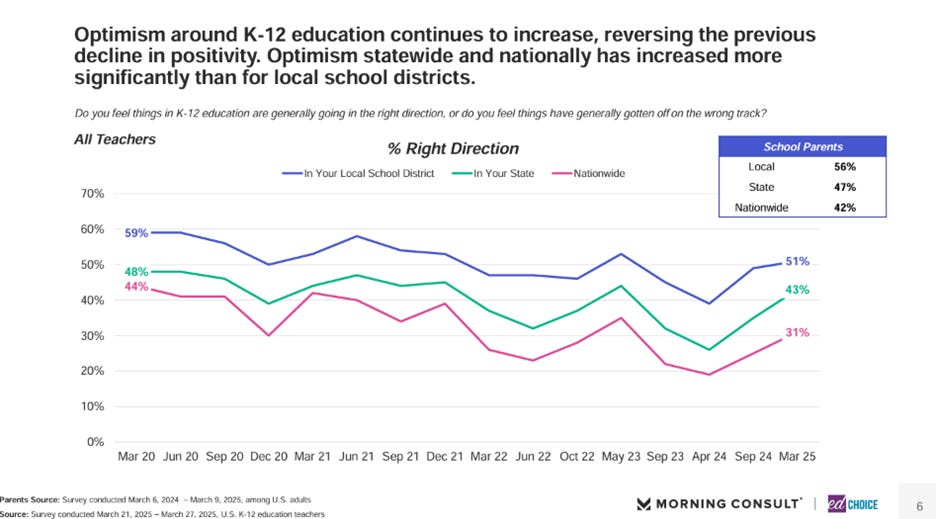
Starting from the place we left off; teachers’ attitudes have bounced back after plummeting to all time low levels last spring.
· 31% of teachers believe that education is heading in the right direction at the national level (up 12 points).
· 43% of teachers believe that education is heading in the right direction at the state level (up 17 points).
· 51% of teachers feel that education is heading in the right direction at the local level (up 12 points).
Teachers, especially those in private schools, are much more likely to recommend the teaching profession to a friend or family member than last year.
· Just over one-fourth (27%) of all teachers would recommend the profession, up 12 points from last spring.
· The proportion of private school teachers who would recommend the profession has more than doubled in the span of a year (17% in 2024 to 35% in 2025).
It is worth noting, as you can see in the visual below, that there is still plenty of work to do to return to the levels of optimism towards the teaching profession observed from 2020 to 2023.
There are some hints within the report as to why teachers are feeling better as the 2024-2025 school year concludes.
When asked whether they feel that student absences are more frequent now compared to this time last year, 32% of teachers said that they did. This might not seem like a slam dunk, but when we asked the same question a year ago (asking teachers to compare absences in spring 2024 to spring 2023), 40% of teachers said they felt absences were happening more frequently.
We posed the same type of question, instead focusing on misbehaviors in the classroom. About one-third of teachers (34%) said that student misbehaviors are happening more frequently now compared to this time last year. Again, on the surface this may not seem like much to celebrate. Thinking back to last year, however, uncovers signs of progress (or at least a slowing in the rate of decline). Last spring, 47% of teachers felt as though misbehaviors in the classroom were more frequent compared to the year prior (spring 2023). This represents a 13-point decrease in teachers who feel student misbehaviors are occurring more frequently.
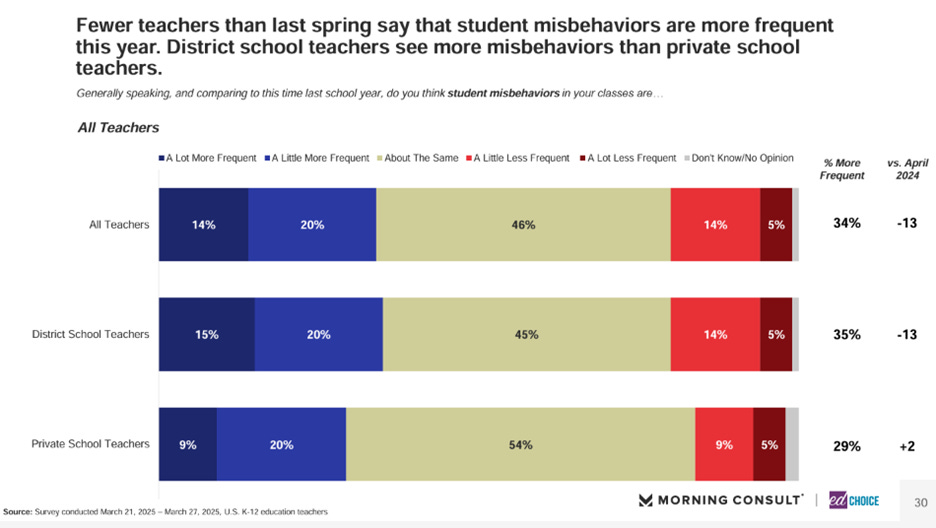
Split out by sector, private school teachers are slightly less likely than district school teachers to feel that both student misbehaviors and absences are occurring more frequently than last year.
The report included multiple questions aimed at learning more about the daily life of teachers inside the classroom. When asked about how often student misbehaviors (verbal outbursts, bullying, etc.) are interrupting class, roughly 40% of teachers said either “rarely” or “never.” This type of classroom interruption is especially uncommon among private school teachers, with over half (52%) replying “rarely” or “never.”
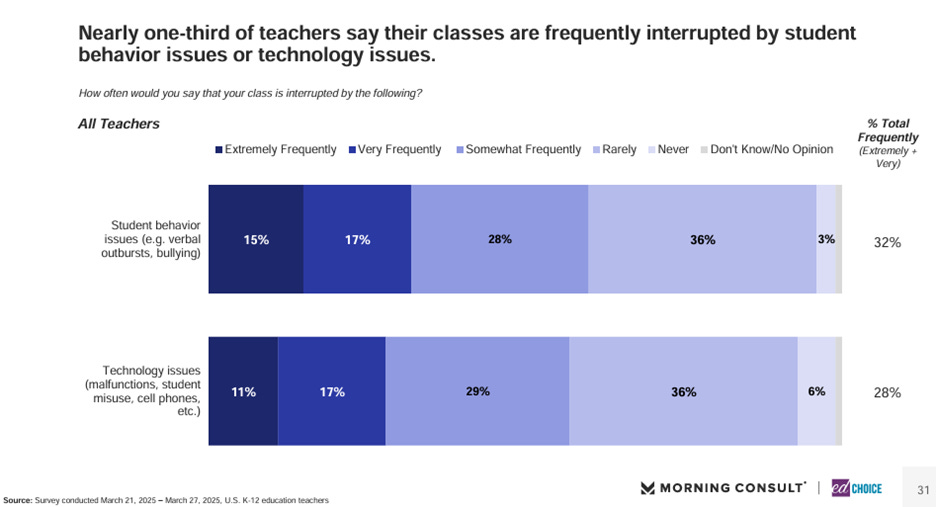
Indeed, it appears that conditions inside the classroom are improving in the eyes of teachers. It echoes other areas of the survey as well, including questions examining teacher wellbeing and student progression.
Perhaps this is the result of a natural ebb and flow of the K-12 classroom environment. Or could it be something sturdier, more sustainable? It feels undeniable that K-12 education across the country is in the spotlight once again. If increased optimism among teachers and more functional classroom environments are a product of such a spotlight, we may be headed in the right direction after all.
 |
|