
When a Label Doesn’t Stick
Empirically testing if the term “voucher” affects opinions

Since the early 1990s, there are probably just a handful of terms in K-12 education debates that appear to carry as much baggage as school voucher. Opponents of school choice have used the term to signal “privatization,” to assert a drain on public school funding, or simply to stoke negative connotations. Media outlets, too, often fall back on voucher as shorthand—even when the program being described is something that is functionally different from a private school voucher program – such as education savings accounts (ESAS) and tax-credit scholarship programs.
A month ago, a story in The Washington Post carried the headline “Public schools are closing as Arizona’s school voucher program soars.”
But Arizona’s program is not a voucher at all! It is an education savings account (ESA) program, which deposits funds into restricted-use accounts that families can access and use for private school tuition, tutoring, online courses and curricula, or other approved services. Similar mislabeling happens often in media reporting as well as advocacy. (See recent commentary by high-profile opponents who routinely conflate ESAs and tax-credit scholarships under the catch-all “voucher” label.)
Policy type distinctions are not trivial. As many policymakers, policy wonks, and advocates can attest – the design of programs and policies affects who participates, how funds flow, and what educational options are possible. Comingling distinct program types – which have observationally different mechanics and operations – under a single word misinforms readers and muddies public understanding.
After years of following the public debates, stories, and headlines, the mislabeling seems to reflects a deliberate strategy by choice opponents: to collapse the growing diversity of educational choice policies into one term with decades of perceived political baggage.
That leads to an empirical question we can test via survey experiment:
What effect does the “voucher” label have among the general public? And not only among those who are in the politics, policy, and advocacy arenas.
The Experiment
In a working paper I wrote for a recent conference hosted by Program on Education Policy and Governance (PEPG) at the Harvard Kennedy School, we tested this very issue. Our survey experiment compared public responses to a general description of what a school voucher does against an alternate version – same description but that explicitly using the term “school voucher.” The objective was simple: measure whether the term itself carries a negative or positive influence in shaping respondent opinion.
The result? Not much happened.
Across the full sample, support levels barely budged between the no-term description and the version that included the school voucher term. The very small differences in the responses fell well within the margin of error.
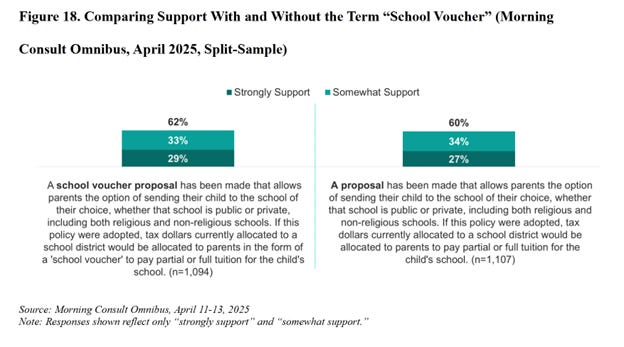
Subgroup analysis by partisanship, income, race, and parent status yielded similar patterns with any differences within or on the borderline with respective margins of error. In other words, the label “school voucher” had little measurable impact.
For those expecting a sharp drop when “school voucher” entered the wording, the experiment offers a reality check. The public, at least in an online survey context, appears more focused on the mechanics of what’s described than the policy name applied to it.
Why the Disconnect?
One possibility is that the term “school voucher” simply doesn’t influence with the broader public in the ways it may have years ago. For many Americans, school choice encompasses a set of public policies and programs. School vouchers, ESAs, tax-credit scholarships, charter schools, and even now microschools seem to occupy the same psychological space. Policy labels blur. People respond to the basic idea of giving families schooling and learning options. Precise terminology may not matter to ordinary Americans like it does to those of us (like me) who can (sometimes?) fixate on program design, function, operations, and so on.
Another possibility is saturation. After years of headlines, debates, and campaign rhetoric, the term “school voucher” may no longer deliver the jolt that opponents expect. It’s familiar, but familiarity doesn’t necessarily equal distinct persuasions.
Whatever the explanation, the evidence suggests that opponents who lean heavily on “school voucher” as a catch-all scare label may not be achieving much at all in terms of shifting broader public or parent opinion. The rhetoric likely energizes their base, but the broader public seems largely unfazed.
What This Means
The evidence from our recent survey experiment should give some comfort to those concerned about the rhetorical effects of conflating policies and mislabeling.
But this finding doesn’t let off the hook media outlets, advocates, or even education researchers. Clear, accurate terminology and descriptions still matter. When news headlines and stories call an ESA or tax-credit scholarship program a voucher, they misinform and misguide casual readers and policymakers alike about how the program functions.
The better path for all parties is clarity. Take care describing school choice policies by what they do. Distinguish between school vouchers as single-use for school tuition; a government-funded education savings account with flexible spending and multiple uses; and scholarships for school tuition and funded by tax-credited donations to scholarship granting organizations (SGOs). Parents and the public deserve this kind of precision.
On the one hand, the term “school voucher” will likely continue to be used by opponents as a signal to rally the base under the bright political lights. The experimental data suggest that signal has limited reach to the vast majority of Americans and parents. But on the other hand, we owe it to parents and guardians to be clear about the policies and programs we are supporting and debating so they can be well-informed and prepared for the important decisions on how to find the best way to educate their child.
 |
|